Rebecca Schmitt
Berlin Marathon 2026 · Behind the Scenes / Athlete Stories
"From mile 24 and on, the adrenaline kicks in for me, and I remember that I have nothing to lose by laying it all on the line."
Race Execution · Performance · Product · Quick Fire
There are few marathon finish lines quite like Berlin's. For Rebecca Schmitt, running through the Brandenburg Gate after more than 26 miles of racing was a moment that still gives her chills.
At the 2026 Berlin Marathon, Rebecca delivered a remarkably controlled performance, crossing the finish line in 2:27:38to become the fastest female PUMA PROJECT3 finisher in the race.

Berlin Sportograf
The result was the culmination of months of consistent training, a carefully considered pacing strategy, and a renewed focus on nutrition. But for Rebecca, the satisfaction came from more than the finishing time. It was knowing that the preparation had translated into exactly the kind of race she had set out to run.
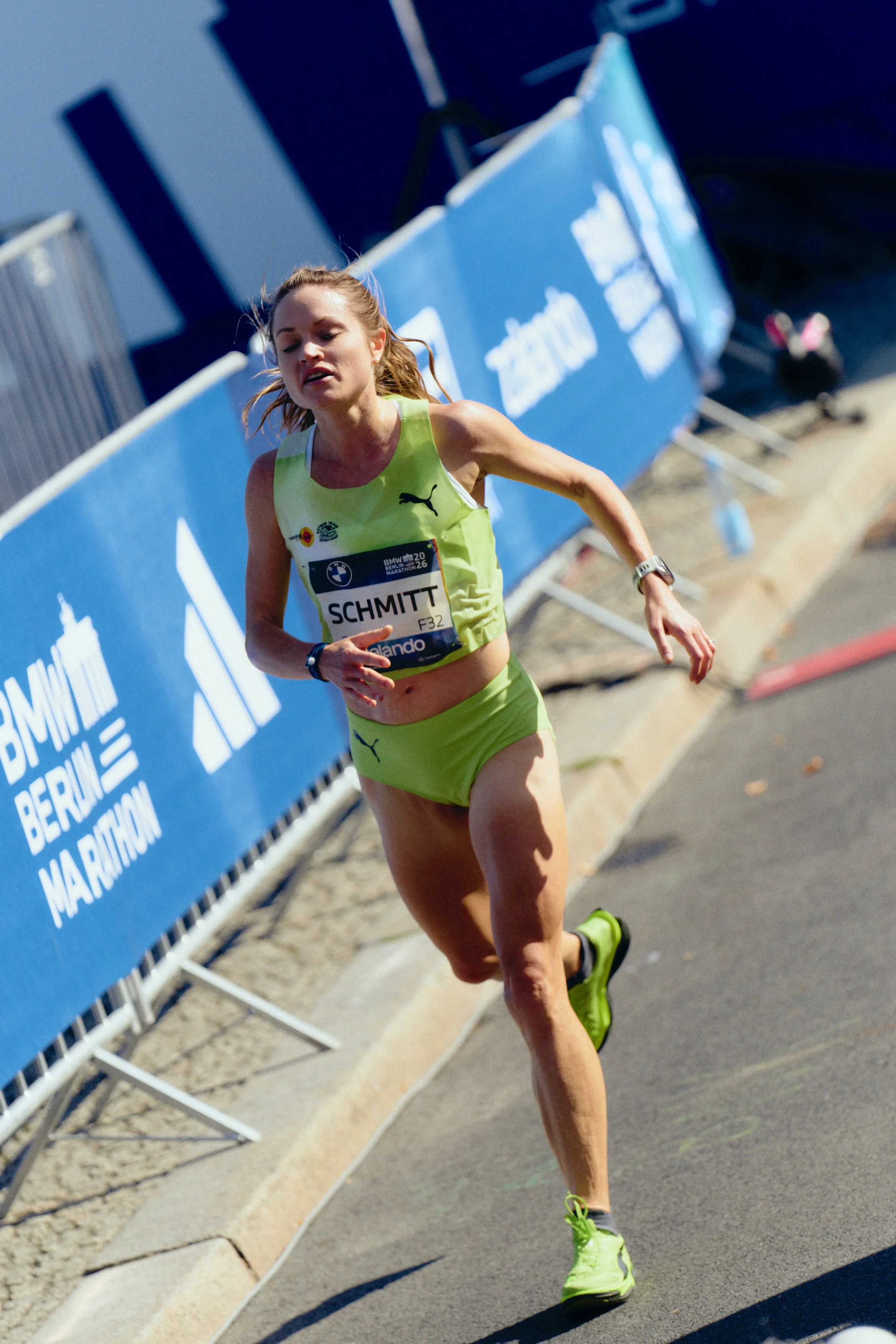
A race plan built around 2:26–2:27
Throughout her marathon training block, Rebecca had been working toward a finishing time in the 2:26–2:27 range. Her approach was measured from the start, aiming to maintain an even pace and leave enough in reserve to finish strongly.
According to her watch, she averaged approximately 5:35 per mile. Accounting for course crowding, water stops, and the additional distance inevitably covered when navigating a major marathon, her overall average was closer to 5:38 per mile. Coming through halfway in approximately 1:14, Rebecca realised she was slightly behind her intended pace.
Rather than allowing that to disrupt her race, she made a small adjustment. “My splits were even for most the race, and I managed to have a slight negative split in the second half.” The decision paid off. Rebecca maintained her momentum through the latter stages, ultimately crossing the finish line in 2:27:38.
Looking back, she believes there may even have been room to push slightly harder earlier in the race. “I think I could have gone out a tiny bit faster.”
When the marathon really begins
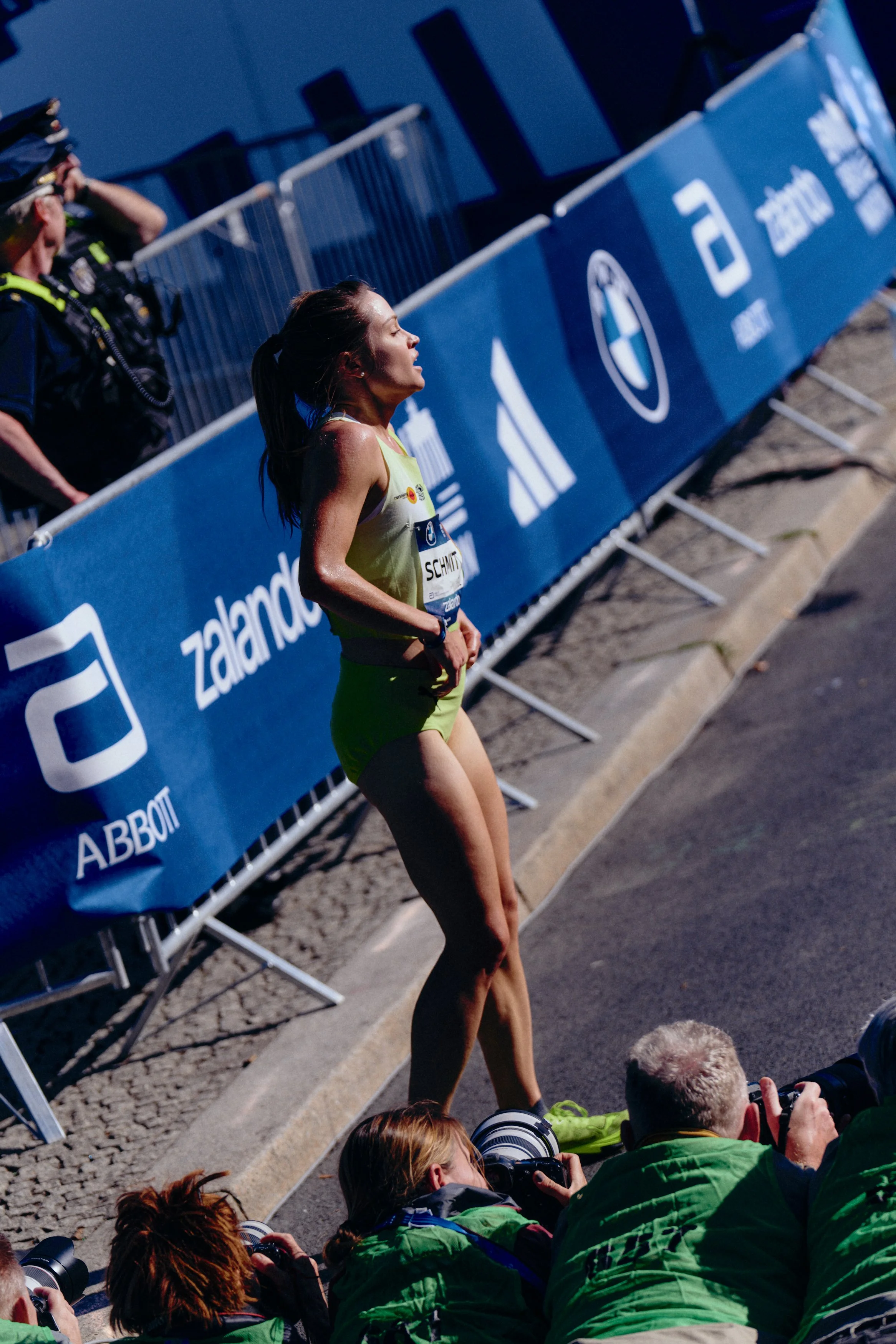
Ask Rebecca which part of a marathon is the most difficult, and she has a clear answer: miles 18 through 23. It's the point where the accumulated effort begins to register, but the finish line still feels some distance away.
In Berlin, her legs began to tire around mile 23, although she felt comfortable from a cardiovascular standpoint. Her approach to the final miles is as much psychological as physical.
“From mile 24 and on, the adrenaline kicks in for me, and I remember that I have nothing to lose by laying it all on the line.”
That willingness to commit fully to the final stretch helped Rebecca maintain her effort through the closing kilometres. And then came the Brandenburg Gate. “Cruising through the Brandenburg Gate! I get chills thinking about it.”
For an athlete who had spent months preparing for one specific race, the iconic Berlin landmark marked the moment when all that work was about to become a result.
Why fueling became a priority
Rebecca is quick to acknowledge that successful marathon performances are rarely the product of a single workout or last-minute adjustment. “A good race is ultimately made in the training— in the workouts, long runs, and mileage over the course of the entire block.”
For Berlin, however, one particular change stood out: a more deliberate approach to carbohydrate loading. Through PROJECT3's educational resources and video calls, Rebecca gained access to guidance from sports nutrition expert Maddie Alm.
She used that information to rethink how she approached the days leading into the marathon, implementing a structured carbohydrate-loading strategy rather than relying on her previous habits. “The nutrition resources (Maddie Alm) were extremely helpful to incorporate, and I implemented a proper carb load prior to the race.”
Alongside the fueling adjustments, Rebecca maintained the foundations she considers essential to marathon performance: consistent mileage, quality workouts, long runs, sufficient sleep, and good nutrition.
Her training peaked at more than 90 miles per week, providing the endurance required to sustain her target pace through Berlin's 26.2 miles.
Why Rebecca chose the Deviate Nitro Elite 4
For race day, Rebecca opted for the PUMA Deviate NITRO Elite 4, valuing its combination of responsiveness, comfort, and stability. While both the Deviate NITRO Elite and FAST-R are designed for competitive racing, Rebecca has developed a clear personal preference.
“I like the Deviates more than the Fast-Rs because they are more forgiving when running form degrades at the end of a race.” That distinction matters over the marathon distance, where maintaining running mechanics can become increasingly challenging as fatigue accumulates.
Rebecca described the Deviate NITRO Elite 4 as comfortable and responsive throughout the race, with the stability she prefers when pushing through the later miles. Her choice reflects an important consideration for competitive runners: finding the footwear that best complements their individual running style and race-day needs.
Quick fire
Berlin Marathon finishing time: 2:27:38
Race-day mindset in three words: Trust your training.
Race moment you're most proud of: Cruising through the Brandenburg Gate.
Finish-line emotions: Relief and gratitude.
Race-day footwear: PUMA Deviate NITRO Elite 4.
Peak training mileage: More than 90 miles per week.
Reflection
With Berlin behind her, Rebecca is already considering what she might change for her next marathon.
Her plans include gradually increasing her training volume beyond the 90-plus miles per week she reached during this build and potentially introducing slightly faster workout paces. The immediate focus, however, is a different distance.
Rebecca has her sights set on the Houston Half Marathon, with the possibility of returning to the marathon distance at Chicago in 2027. After a performance as controlled as Berlin, the next question is how much more she might be able to achieve.
For now, though, one memory stands above the rest: running through the Brandenburg Gate, knowing that months of preparation had delivered.
About PROJECT3
PROJECT3 is PUMA's performance-based running community for sub-elite athletes. These are the runners pushing the limits of what's possible while holding down careers, families, and real lives. Built on achievement and not traditional sponsorship. The 2026 PROJECT3 incentive structure rewards PBs, fastest finishers, and the largest improvements across Boston, London, and beyond.
Follow PROJECT3 for race reports, athlete stories, and always-on performance content across the full marathon season.