You Belong Here: Kristoffer Mugrage's 2:13:33 Boston Breakdown
Kristoffer Mugrage
Boston Marathon 2026 · Behind the Scenes / Athlete Stories
"The entire last 5 miles I was thinking about running with all my friends, old teammates, family and coaches — and being excited about how fast I was running."
Race Execution · Performance · Product · Quick Fire
Before the 2026 Boston Marathon, Kristoffer Mugrage told his friends and family he thought he could run 2:13:30. He ran 2:13:33.
That's not luck. That's race intelligence: the product of a training block built specifically for this course, a five-part race plan executed almost without deviation, and the kind of self-belief that holds together over 26.2 miles of one of the most technically demanding marathon courses in the world.
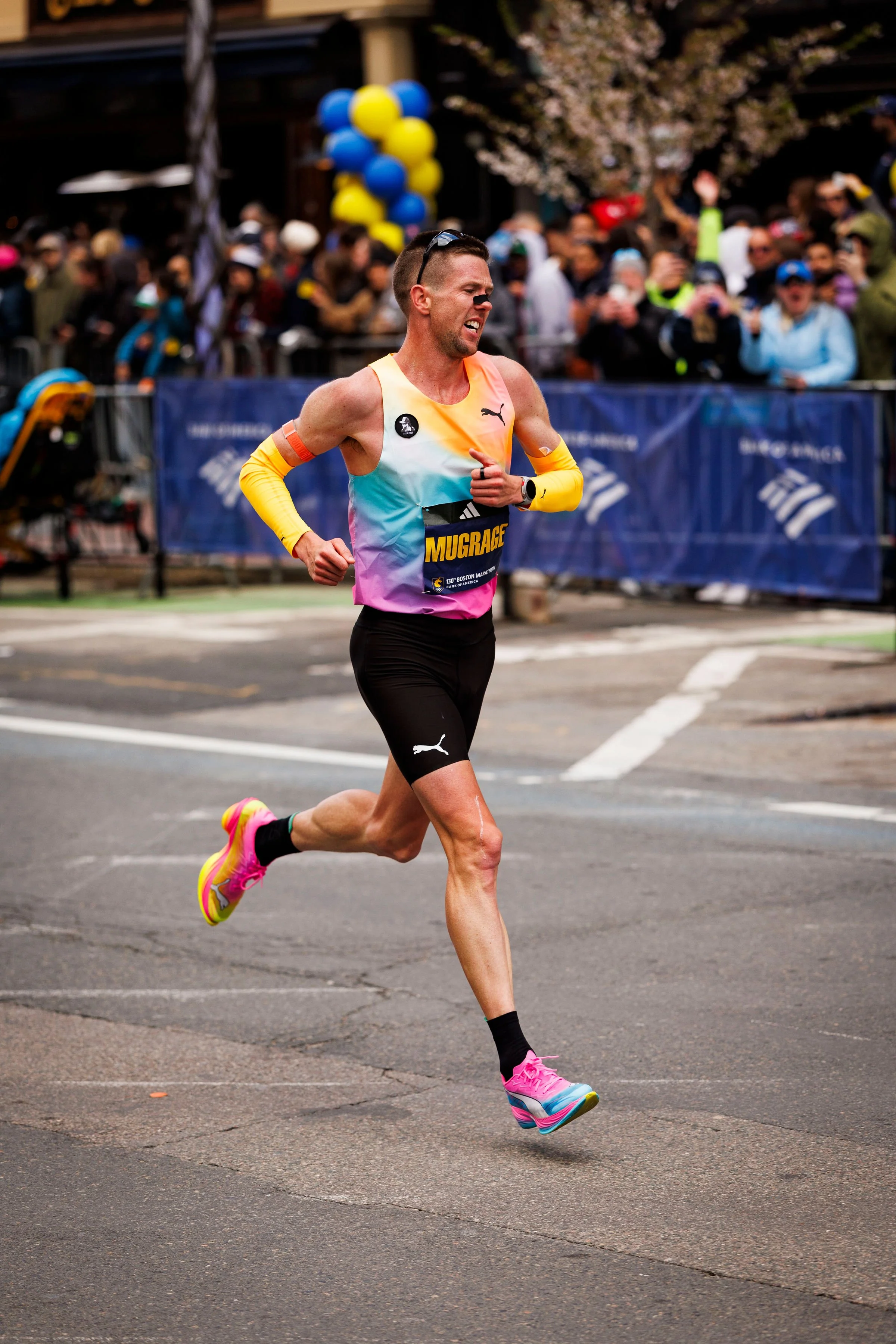
Mick Stana Creation
Kristoffer finished as the fastest PROJECT3 male at Boston 2026, claiming the $3,000 performance award in a race where he spent most of the 26 miles entirely alone, running on instinct, effort, and a mile 24 split of 5:01 that most sub-elite athletes will never run that late in a marathon.
This is how he did it.
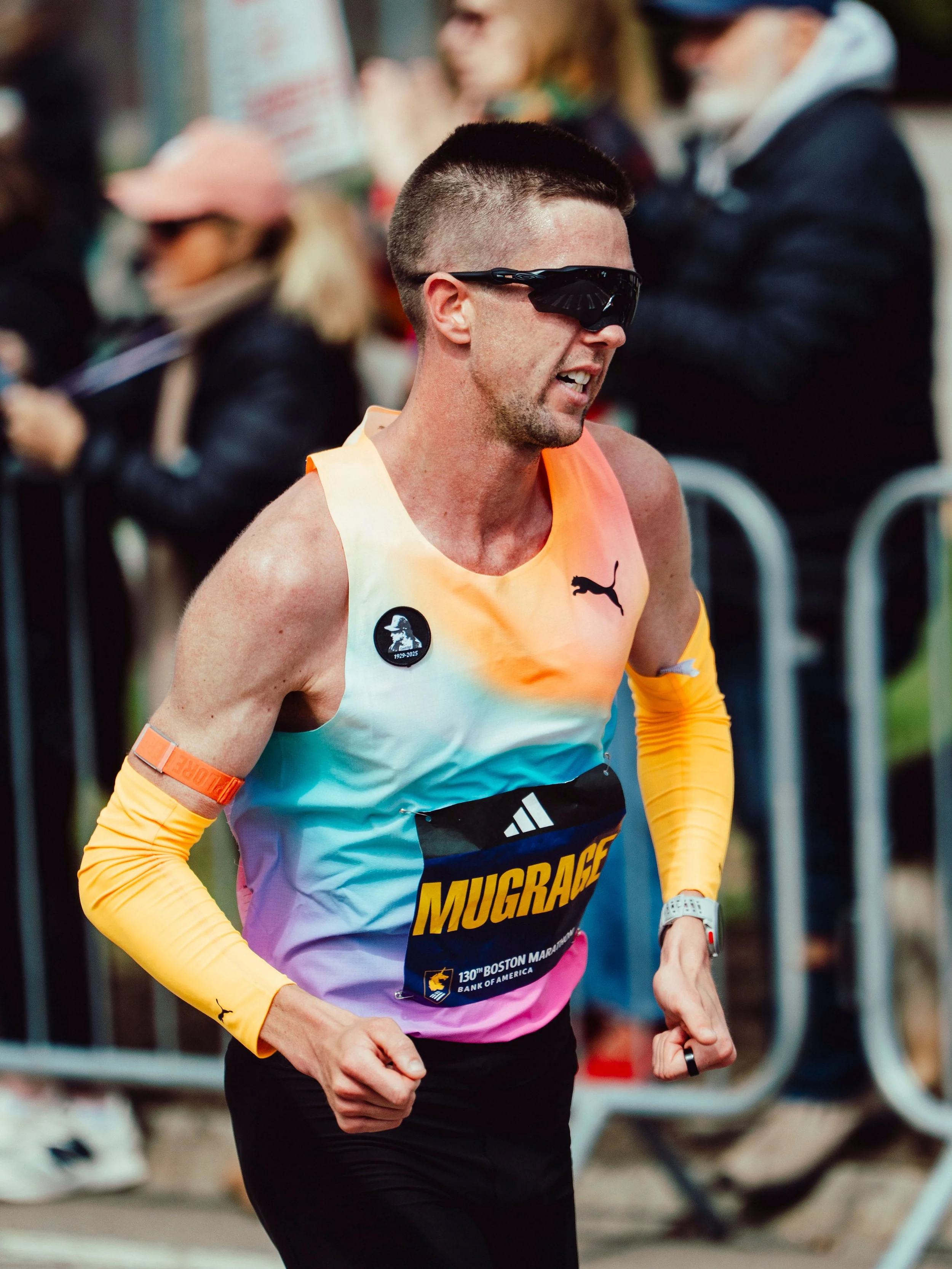
Mick Stana Creation
Race Execution
What was your race plan going in, and how closely did you stick to it?
"Going into the race, I told a lot of my close friends and family I think I could run 2:13:30 on the course with how my training had gone. The plan was to get out fast the first few miles, use the downhill, bank some time for the Newton Hills and then let the last 5 miles rip."
Kristoffer broke the race into five distinct sections — not as a loose framework but as a committed psychological structure:
0–6 Miles: Comfortably Uncomfortable
6–10 Miles: Find Your Pace
10–16 Miles: Anticipate the Hills
16–21 Miles: Effort Through the Hills
21–Finish: Make it Hurt, No One Passes You
"I feel as though I followed the race plan perfectly. Couldn't have executed any better."
The five-part model is worth noting for any sub-elite athlete preparing for Boston. Breaking the course into segments with distinct mental instructions — rather than chasing a single pace target from the gun — is exactly the kind of race architecture that holds up when things get difficult. And at Boston, things always get difficult.
What pace strategy did you follow, and where did the race change for you?
"My pace strategy was to get out fast the first half, wanting to go through anywhere from 66:00 to 66:30. From the beginning I got out a bit hotter than I was planning — 4:45 first mile, 4:53 second, 4:55 third — which slightly worried me. But the plan was to take a big swing, so I trusted myself and found my pace after the first 5k."
He came through the halfway mark in 66:06 — right on target. But the internal monologue at that point is honest:
"I thought 'Perfect, I am right where I need to be.' But I was also thinking, 'Man, my legs are already a bit sore, and I have another 13 miles to go.' But once I took my bottle and caffeine gel at 20k, I felt great for the rest of the race. The race really changed for me after Heartbreak Hill — I felt great coming over the top and was able to catch a few guys over the last 5 miles."
What was the hardest point in the race, and how did you manage it?
"The hardest part was miles 19–21. Things were going great up to that point as I felt like I was in flow state for most of the race. But right around 19 miles I dropped my bottle off the table and had to stop and turn around to grab it. I felt my legs tighten up a little bit, but I just told myself everything would be okay and focused on effort."
A dropped bottle at mile 19 of a 2:13 marathon attempt. The margin for error at that pace is almost zero- a few seconds of disruption, legs tightening on a cold stop, and the whole second half can unravel. Kristoffer's response was to narrow his focus entirely.
"Once I summited Heartbreak Hill I thought it wasn't that hard — 'This is easy, you've been here before.' I felt great coming over it, aerobically very strong, and wanted to push. But I could feel my hamstrings start to cramp, so I had to change my form on the downhills to make sure I didn't seize up. I made sure to attack the flat and uphill sections instead."
"The entire last 5 miles I was just thinking about running with all my friends, old teammates, family and coaches, and looking forward to seeing them at the finish line. That's what was getting me through the last 8k, as well as being excited about how fast I was running and knowing I could PR big."
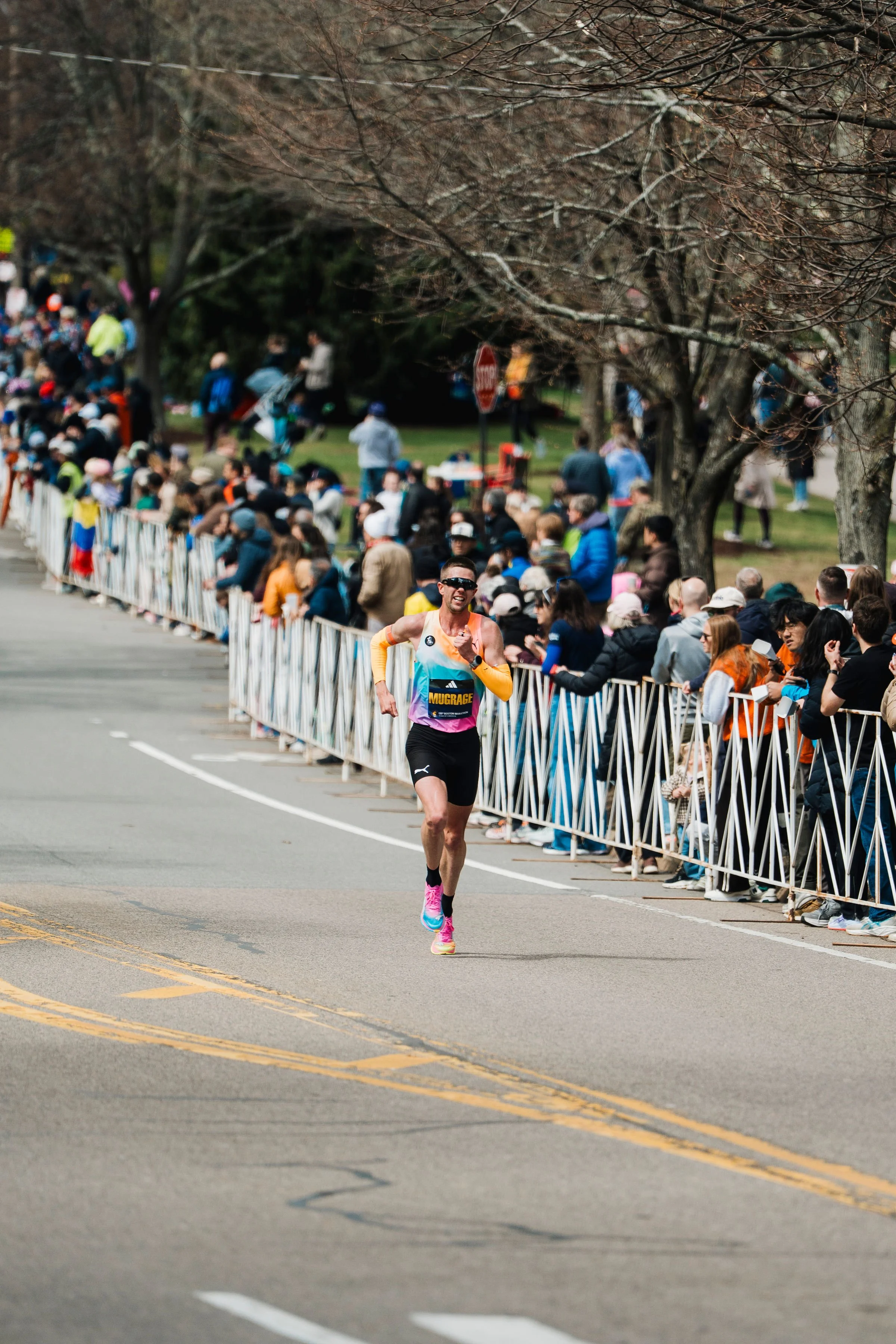
Mick Stana Creation
Performance
What do you think made the biggest difference to your result?
"This build was the most specific training for a course I have ever prepared for. A lot of rolling, hilly long runs at 8,000–9,000 feet. A lot of downhill 400 repeats, a lot of uphill 400 repeats. And stacking a shorter 12-week marathon build right after a long 24-week build this past fall."
Course-specific preparation is still underutilised at sub-elite level. Most athletes train hard for the marathon distance in general. Kristoffer trained hard for Boston, specifically replicating the elevation profile, the hill gradient, and the downhill stress on the quads. The result was a second half that held together when most athletes at that pace start to fracture.
"I really enjoyed the process of training this winter, even though I did a lot of it indoors on a 200-metre track. The consistency and staying healthy really added to the adaptation and increased my fitness."
Was there anything you adjusted in preparation that paid off?
"A lot of things. I typically run high mileage. Around 125–135 miles per week on a three weeks up, one week down cycle, with down weeks still hitting 100 miles. But because I was coming off a long build and a late December marathon, I decided to lower my mileage and train at 120 miles per week average for 11–12 weeks straight. Overall my workouts were just more quality and tempos faster than I've ever run and feeling good with everything."
The decision to prioritise quality over volume coming off a heavy block is one that takes confidence to make, particularly for athletes who use mileage as a proxy for fitness. Kristoffer trusted the process, kept the load sustainable, and arrived at the start line fresh enough to execute a 66:06 first half and a 5:01 at mile 24.
Product
How did the PUMA Fast-R3 perform across the course?
"It performed exactly how I expected. I ran in the Fast-R3 for my previous marathon PR at the Marathon Project in December. It was great then and even better for the Boston course. I used the Deviate Elite 4 a lot in training and loved it, but knew the Fast-R3 would be my race day shoe. It just feels fast and is so smooth no matter what surface you are on."
Did you notice any difference in efficiency compared to previous races?
"The shoes helped a lot on both the downhill and uphill. They were keeping me rolling forward and up on my forefoot. A smooth ride while also being responsive. My legs weren't that beat up afterwards, and my feet were the least sore compared to any other shoe I've worn in a marathon."
Two PRs in the Fast-R3 now: December's Marathon Project and Boston 2026. That's not a coincidence, and Kristoffer isn't treating it as one.
Recognition
What does it mean to you to be the fastest PROJECT3 finisher?
"It's really special. After last year seeing what PUMA did for PROJECT3 at Boston in their first year, it only added to my FOMO of not racing it. To come back this year and run a PR with PUMA and PROJECT3 was really the icing on the cake. The overall support was a big help and I really felt like part of the PUMA Fam."
When did it register that you'd delivered that performance?
"I thought about it a little in the last 10k and I knew a few other guys I was keeping an eye on throughout the race, but they were mostly behind me from the beginning. I did pass another athlete in the same PUMA kit around mile 23, which added to my confidence. I told myself Rory was the only other PUMA guy in front of me… I don't know if that was true or not, but I believed it. I wasn't 100% sure until my buddy Mitchel Dervin confirmed I was the top PROJECT3 athlete when I finished."
That last detail matters. A 2:13 performance, confirmed not by a leaderboard or a brand announcement, but by a friend at the finish line. That's the culture PROJECT3 is building: performance validated by community.
QUICK FIRE
Race day mindset in 3 words: You Belong Here
Split you're most proud of: Mile 24: 5:01/mi
One word to describe the finish: Elation
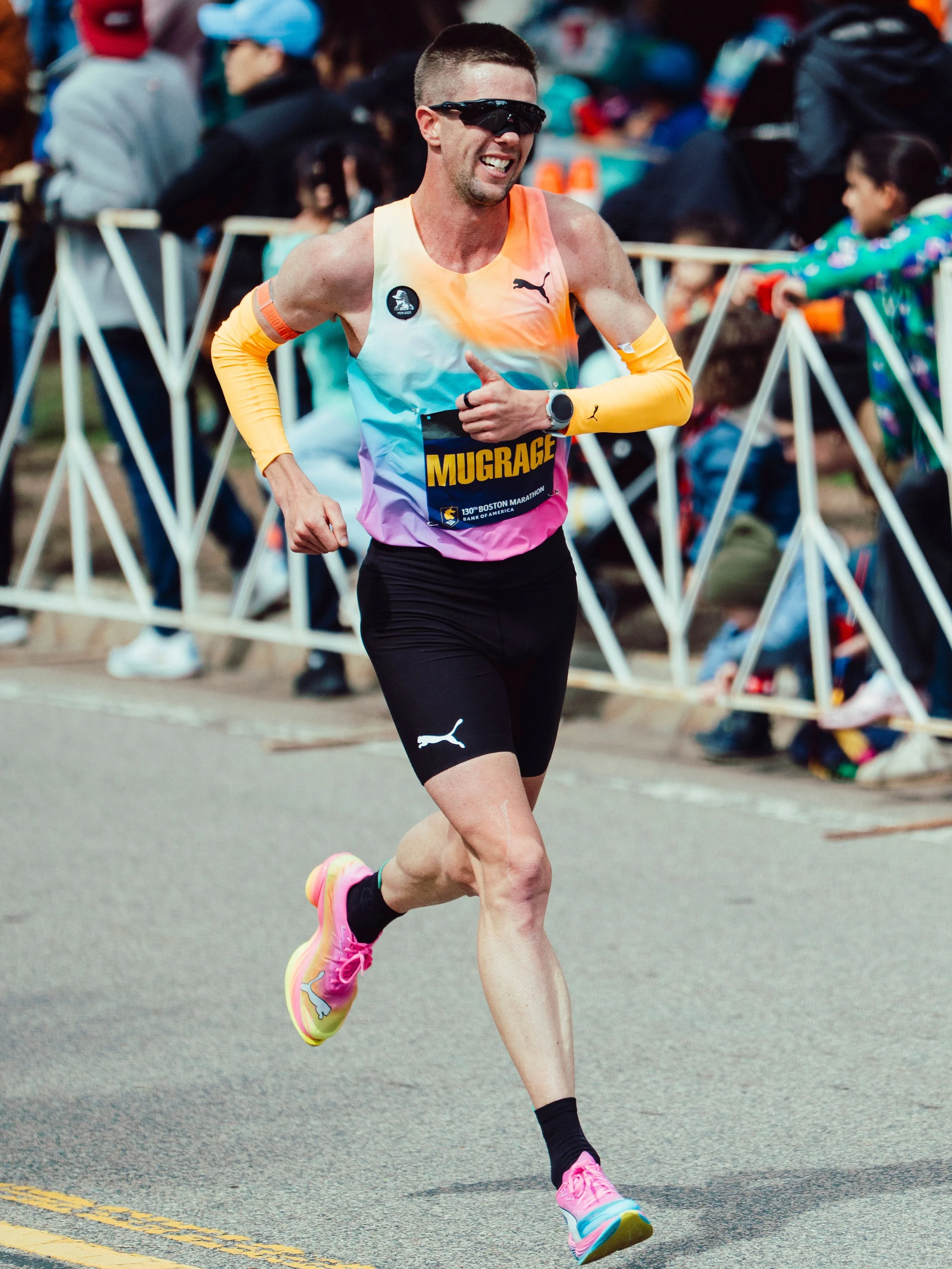
Mick Stana Creation
Reflection
What would you refine going into your next race?
"To trust that I can go out fast and hold on. Don't be afraid to put yourself in the race and know that you are a second half racer."
He ran a 2:13:33 and wants to go out harder. His next target is 2:11:30 at Chicago this fall. If the training consistency holds and the course-specific preparation carries over, that number is well within reach.
What's next?
"Chicago Marathon this fall. I hope to participate in PROJECT3 again if they will have me. Shooting for 2:11:30."
PROJECT3 should absolutely have him back.
About PROJECT3
PROJECT3 is PUMA's performance-based running community for sub-elite athletes. These are the runners pushing the limits of what's possible while holding down careers, families, and real lives. Built on achievement and not traditional sponsorship. The 2026 PROJECT3 incentive structure rewards PBs, fastest finishers, and the largest improvements across Boston, London, and beyond.
Follow PROJECT3 for race reports, athlete stories, and always-on performance content across the full marathon season.